

In the world of turbodiesel performance, the turbo downpipe is often seen as the “first key” to unlocking your engine’s true potential. For Duramax L5P or LML owners, the restrictions in the factory exhaust design do more than just choke off horsepower—they also keep exhaust gas temperatures (EGTs) dangerously high.
When it comes to upgrading, you’re faced with a classic question: do you go with the balanced, more compliant nature of a catted downpipe, or the raw, high-flow performance of catless downpipes? This article takes a deep dive into the structural differences between the two and provides a professional downpipe exhaust buying guide tailored to the factory design flaws of the LML and L5P. Whether you’re chasing that crisp turbo whistle or looking for maximum reliability while towing heavy loads, this comparison will give you the clarity you need to choose with confidence.
What Is a Turbo Downpipe?
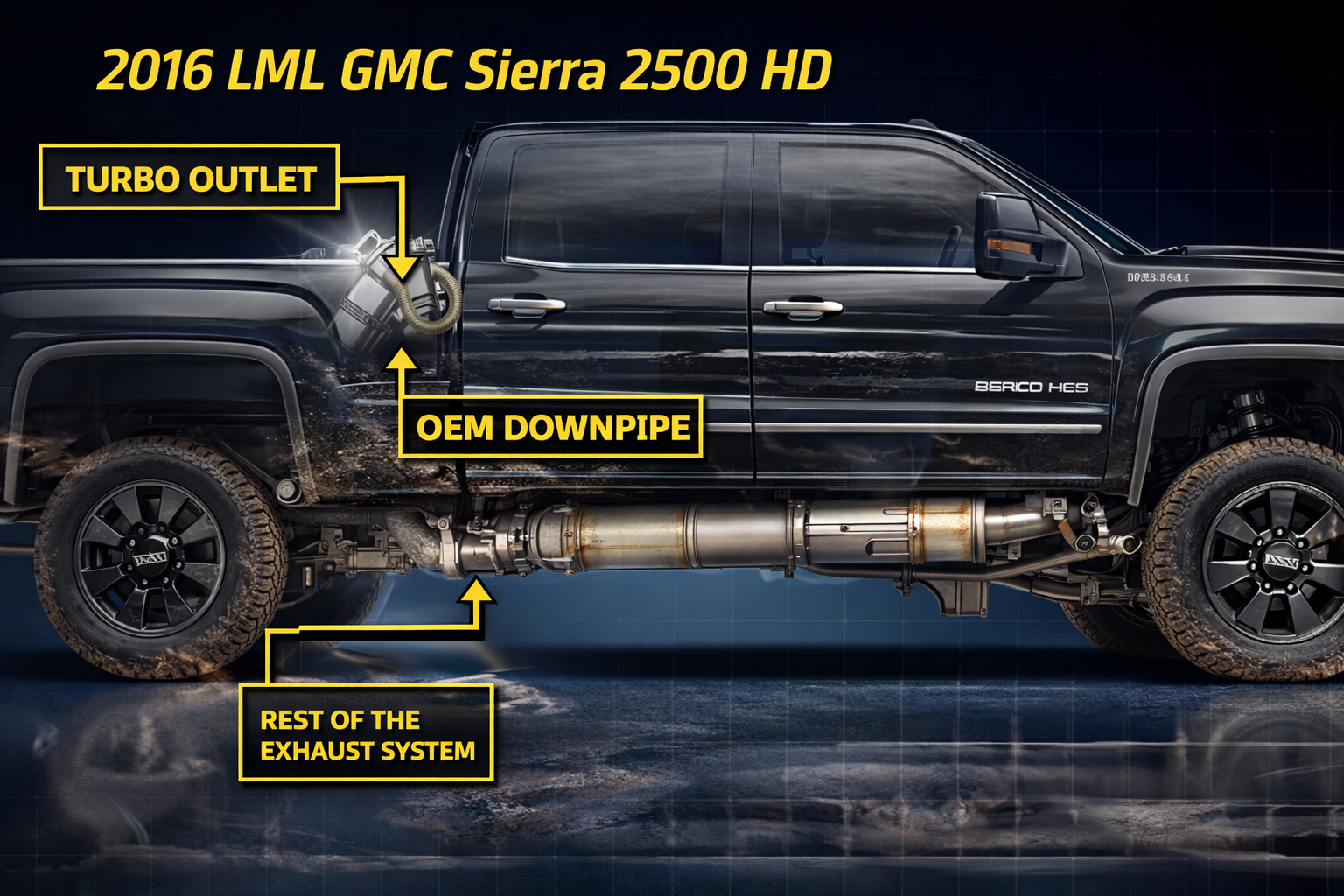
When discussing how to improve your truck’s performance, the turbo downpipe is one core component you simply can’t ignore. Put simply, it’s the first pipe that connects the turbocharger outlet to the rest of the downpipe exhaust system. On large-displacement diesel engines like the Duramax, the factory downpipe is often heavily twisted and restricted in diameter in order to meet noise-control requirements and strict emissions standards. It’s like taking an eight-lane highway and suddenly forcing it into a tiny one-lane toll booth—no matter how much exhaust the engine can push out up front, severe “traffic congestion” happens right there.
By upgrading to a high-performance downpipe exhaust, you can eliminate that performance bottleneck, significantly widen the exhaust path, and reduce backpressure. Whether you choose catless downpipes for maximum flow or a catted downpipe for a more balanced emissions-conscious setup, the most immediate benefits of upgrading this component are faster turbo spool-up, noticeably lower EGTs, and a fully opened “exhaust valve” for future tuning potential. If you’re looking for a specific upgrade such as an L5P downpipe or LML downpipe, understanding its importance as the “throat” of the exhaust system is the first step in making the right upgrade decision.
Deep Dive: Catted vs. Catless Downpipes
In the diesel turbo aftermarket, the downpipe is a critical component that affects exhaust efficiency, turbo response, and EGT control. Whether you drive a Duramax, Cummins, or Powerstroke, choosing between catted and catless is essentially a trade-off between daily-driver friendliness and maximum performance.
Catted Downpipe (High-Flow Catalytic Downpipe)
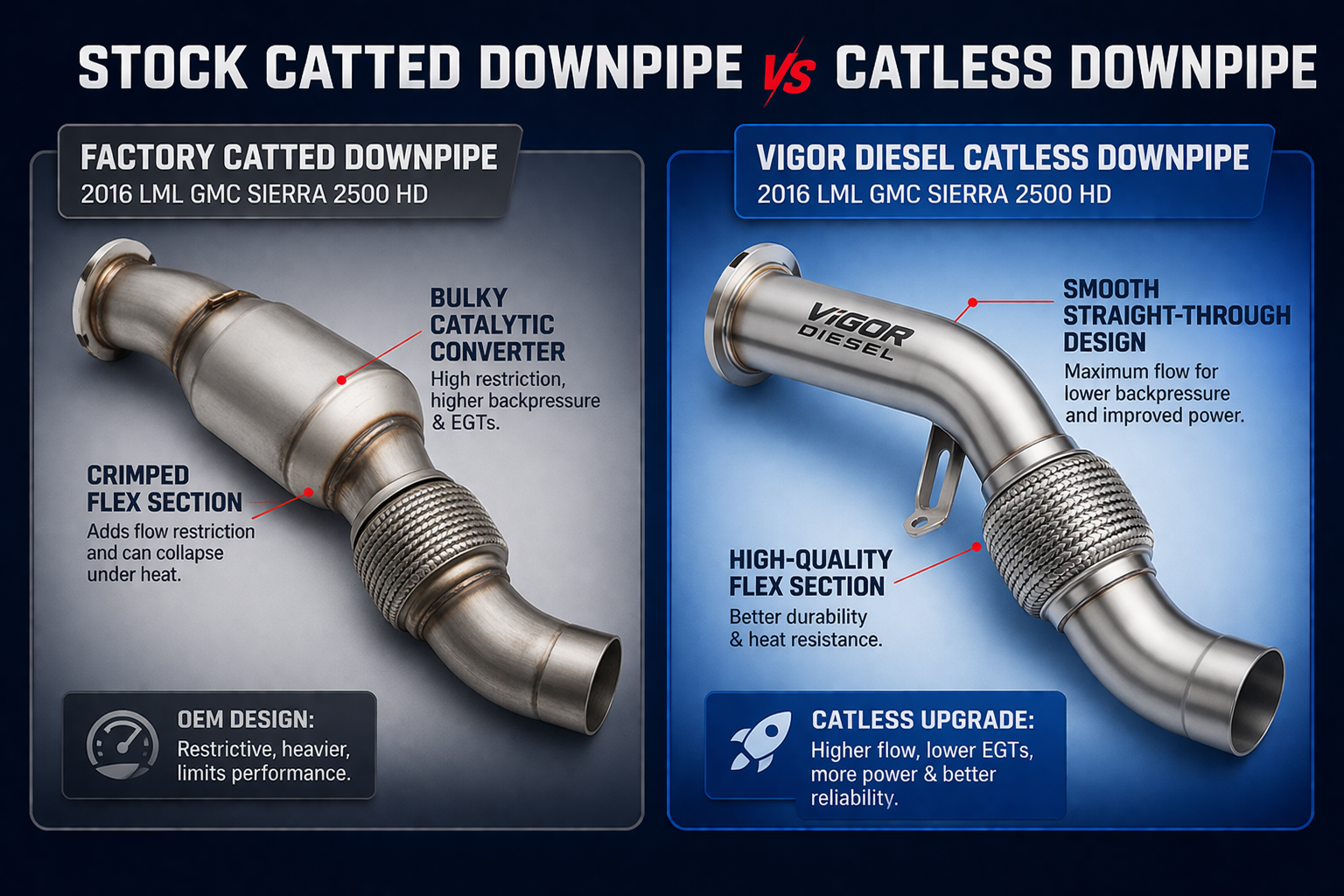
The core idea behind a catted downpipe is to improve exhaust efficiency while preserving a better everyday driving experience. It does not simply retain the factory’s highly restrictive design. Instead, it uses a high-flow metallic catalytic structure that lowers backpressure while still maintaining a certain level of exhaust-treatment capability.
Balanced Performance and Daily Usability: Compared to the restricted factory setup, a high-flow catted downpipe helps exhaust gases flow out more smoothly, improves turbo response, and delivers more responsive performance. For drivers who want to improve the truck’s driving feel without going too extreme, it’s usually the more balanced choice.
A More Pleasant Smell and Better Overall Street Experience: Because it still retains some degree of exhaust-treatment capability, a catted setup can usually reduce exhaust odor and make the vehicle behave more like a daily-driven truck. Compared to a fully straight-through setup, it is also more likely to reduce the chances of triggering a check engine light, although actual results still depend on the platform, sensor strategy, and the vehicle’s overall calibration.
Higher Cost: Since it uses a high-flow catalytic substrate and precious metals internally, a catted downpipe typically costs more to manufacture than a standard straight pipe. That is the main reason for its higher price.
Catless Downpipe (Straight-Through, No-Catalyst Downpipe)
For drivers who want the highest possible exhaust efficiency, catless downpipes are the more pure performance option. By removing the internal catalytic structure, they allow exhaust gases to exit the turbo through a much more direct path.
Higher Exhaust Efficiency: Without the restriction of a catalyst substrate, exhaust flow is faster and backpressure is lower, which usually creates a more immediate feeling of power delivery. For heavy-duty use, towing demands, or a more aggressive performance build, a catless setup is often the more attractive option.
Lower Backpressure and Better Temperature-Control Potential: On diesel platforms, reducing post-turbo exhaust restriction helps improve EGT control under heavy load. For example, upgrading to a high-performance L5P downpipe can let exhaust flow much more freely on 2017–2025 Duramax engines.
A More Complete Supporting Setup Is Needed: A catless setup is usually not as simple as “just changing one pipe.” On diesel platforms, exhaust hardware upgrades often need to be paired with the right tuning solution in order to ensure that power delivery, fault-code management, and overall drivability all work together properly.
Which Setup Is Right for You?
If you place more value on daily driving, reduced odor, and a more balanced overall driving experience, a catted downpipe is usually the better fit. If your goal is to maximize exhaust efficiency, lower backpressure, and achieve more direct performance feedback, then a catless downpipe is the more aggressive route.
For Duramax, Cummins, and Powerstroke owners, choosing catted or catless is about more than just sound and horsepower. It also comes down to how you use your truck, what your upgrade goals are, and whether the entire hardware-and-tuning setup is properly matched. Only by considering the downpipe, the exhaust system, and the tuning strategy together can you truly unlock the full potential of a turbo-diesel platform.
Targeted Performance: Duramax L5P & LML Upgrades
In the diesel truck world, GM’s Duramax engines are known for their massive torque reserves, but the factory exhaust design often acts like a choke point that keeps that performance locked up. Depending on the model year, the focus of a turbo downpipe upgrade can vary slightly.
2017–2025 Duramax L5P Downpipe
The L5P represents the current peak of Duramax technology, but its factory downpipe design is extremely complex and restrictive.
Upgrade Focus: Because EGT control is especially sensitive on the L5P, choosing a product like the Vigor Diesel 3.5" Catless Downpipe can make a major difference. Its larger 3.5-inch diameter and straight-through design can significantly reduce EGTs under heavy load.
Performance Gains: When paired with the correct tune, an L5P downpipe can help the turbo spool more quickly and eliminate that sluggish delay in throttle response.
2011–2016 Duramax LML Downpipe: Solving the “Performance Bottleneck” at the Source
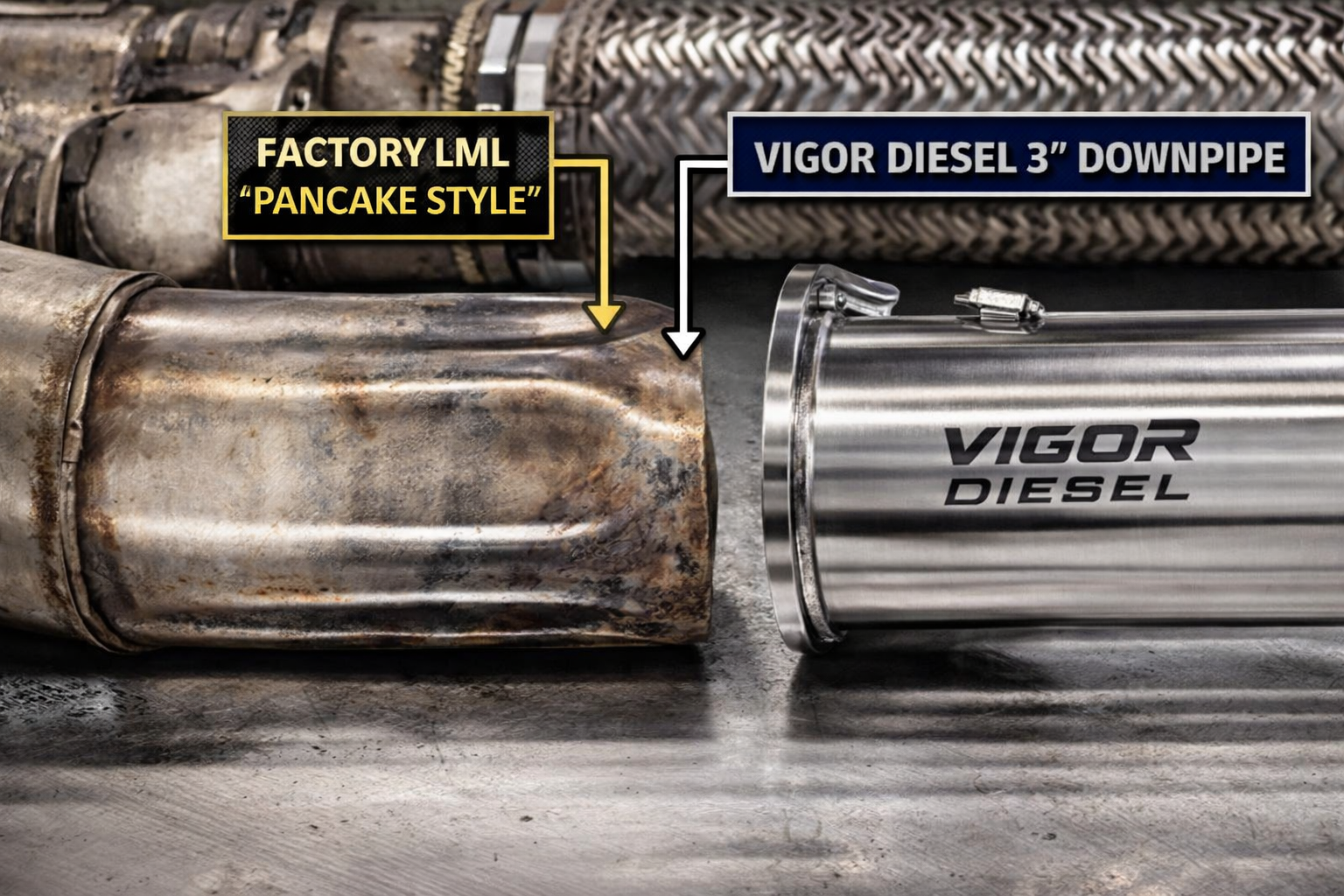
For LML owners, the factory downpipe is the most severe “intestinal blockage” in the entire exhaust system. If you’ve ever looked closely at the stock part, you’ve probably been surprised by its shape. To make room for the firewall and transmission, GM designed this section with a deformed, pancake-style flattened profile.
The Structural Problem: A Dramatic Drop in Cross-Sectional Area
In some areas, the factory LML downpipe loses nearly 30%–40% of its cross-sectional area. That extreme physical restriction causes severe turbulence and backpressure the moment the exhaust leaves the turbo. The direct result is heat buildup inside the turbo housing.
The Core Upgrade: Full 3" Mandrel-Bent Flow
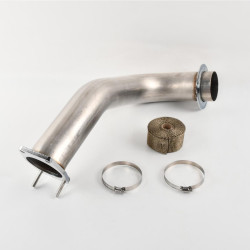
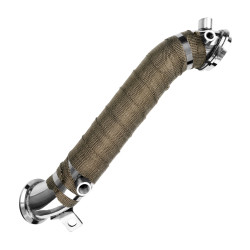
After switching to the Vigor Diesel 3" LML Downpipe, the pipe returns to a true round cross-section and uses mandrel-bent construction. That means exhaust gases can pass through smoothly like flowing water, without being pinched or disrupted.
The Real-World Benefits
- Significantly Lower EGTs: During uphill towing under heavy load, you may see exhaust temperatures 50–100°F lower than with the factory setup. That is critical for protecting both the turbo blades and the engine’s cylinder heads.
- Reduced Turbo Lag: Once backpressure is lowered, the exhaust can drive the turbine more efficiently, so the truck feels much less sluggish from a stop.
- Durability Upgrade: Factory parts are often wrapped in thick insulation that traps moisture and encourages rust. With stainless-steel construction and precision welding, Vigor Diesel’s design dissipates heat more quickly and lasts much longer than the stock part.
Vigor Diesel Professional Recommendation
When choosing an LML downpipe exhaust, many owners hesitate over whether to keep the EGR system.
- If you’ve already completed a full Race Tune, then catless downpipes paired with a straight-through design can fully unleash the raw voice of this 6.6L engine and let you feel pure diesel performance feedback.
- If you still need to retain some factory sensor logic, it is best to consult a professional installer to confirm whether your tuning setup supports the hardware changes involved in a turbo downpipe upgrade.
How to Choose: Which One Is Right for You?
Now that you understand the deeper differences between catless and catted, how do you make the final call? Here are the final recommendations based on real-world use cases:
Daily Commuting and Towing (Best for Balance)
If you mainly drive in the city, or you regularly tow heavy loads legally on public roads, and you don’t want to deal with a strong diesel smell or frequent check-engine-light issues, then a catted downpipe is the better investment.
Core Reason: Even though it costs more, it still improves performance over stock while saving you from a lot of trouble with follow-up maintenance. It is also the more environmentally friendly option.
Heavy-Duty Work and Maximum Performance (Best for Efficiency)
If your truck is a work vehicle that regularly sees farms, job sites, or track use, and you are already planning a complete tuning setup, then catless downpipes are without question one of the best values for the money.
Core Reason: Not only are they more affordable, but more importantly, they completely remove the “roadblock” in the exhaust system. For drivers who spend long hours hauling heavy loads, ultra-low backpressure means the engine can operate more easily, and over the long run, fuel economy may also benefit.
Brand and Service Selection (You’re Not Just Buying a Product—You’re Buying Peace of Mind)
When it comes to upgrade parts like a downpipe, price obviously matters—but what really determines the long-term ownership experience is product precision, installation fitment, after-sales support, and purchase protection. For Duramax owners in particular, a downpipe may look simple, but it directly affects whether the installation goes smoothly, whether the connections line up properly, and whether the truck stays trouble-free afterward.
Why Choose Vigor Diesel?
- Fitment Optimized for Diesel Platforms
Vigor Diesel’s downpipe products are developed around the real needs of diesel-platform owners, with a strong focus on installation alignment, structural fitment, and long-term durability. For Duramax drivers, more consistent fitment accuracy means a smoother installation experience and fewer extra headaches caused by misalignment. - More Direct Pre-Sales and After-Sales Support
Choosing a brand is not just about comparing specs on a product page—it is also about whether someone is truly there to help when you run into a problem. Whether it is confirming the right fitment, choosing the correct version, or troubleshooting common questions before and after installation, professional and timely customer support can save users from a lot of unnecessary detours. For modification-focused customers, that often matters more than simply comparing prices. - Clearer Return Policies and Order Protection
For customers buying upgrade parts online, a clear and transparent return policy and order-handling process can significantly reduce hesitation before checkout. Before buying, customers do not just care about “Can I buy this?”—they also care about “What if I order the wrong one?” and “What happens if there’s a problem?” Clear service policies are part of what makes a brand trustworthy.You can add details here based on your actual policies, such as the return window, applicable conditions, whether uninstalled returns are accepted, and how customer service handles claims.
- More Customer-Friendly Pricing and Better Promotional Value
Beyond the product itself, a smart pricing strategy also directly impacts the customer’s decision. For first-time buyers, coupons, new-customer discounts, or seasonal promotions can lower the barrier to entry and make customers more willing to go from buying a single part to upgrading into a more complete setup.It is recommended that you include real details here, such as new-customer offers, order-threshold discounts, holiday promotions, or exclusive coupon codes for email subscribers.
- A Service Logic Better Suited to Complete Upgrade Planning
For many diesel truck owners, a downpipe is not a standalone upgrade—it is one part of a larger build. A truly mature brand should help customers think through hardware combinations, usage scenarios, and future upgrade paths as one complete package.
Conclusion
Upgrading your downpipe exhaust is not just about gaining a few extra horsepower—it is also about allowing your Duramax engine to operate in a healthier, lower-pressure environment.
Ready to Upgrade?
Click to explore Vigor Diesel Downpipe options and find the best-matched high-performance downpipe for your L5P, LML, or other applications.