

Ford introduced the 6.7L Powerstroke in 2011 as its first fully in-house turbocharged diesel V8 for the Super Duty lineup. Used in the F-250, F-350, and F-450, it quickly gained recognition for delivering strong, practical torque for towing and heavy-duty work.
Output has increased from 400 hp and 800 lb-ft in early models to today's High Output version producing up to 500 hp and 1,200 lb-ft. This steady evolution highlights how 6.7 Powerstroke specs have improved through the 2024–2025 models.
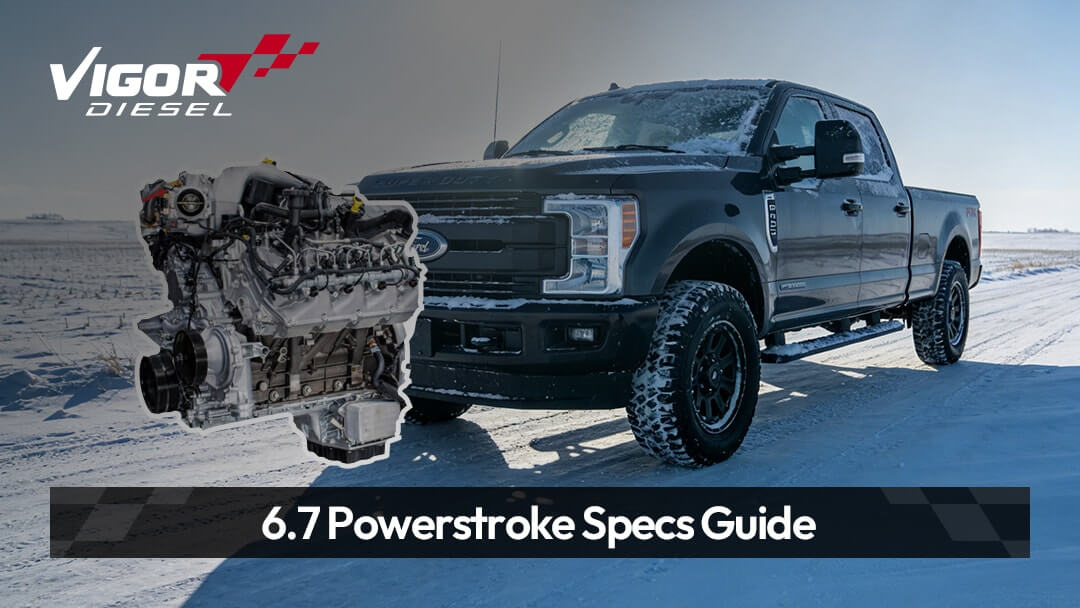
6.7 Powerstroke Engine Overview
In 2011, the 6.7-liter Powerstroke engine replaced the 6.4-liter engine, high-density cast graphite iron of Ford's diesel engine development. This allowed Ford to have more precise control over engineering design, durability, and long-term performance improvements.
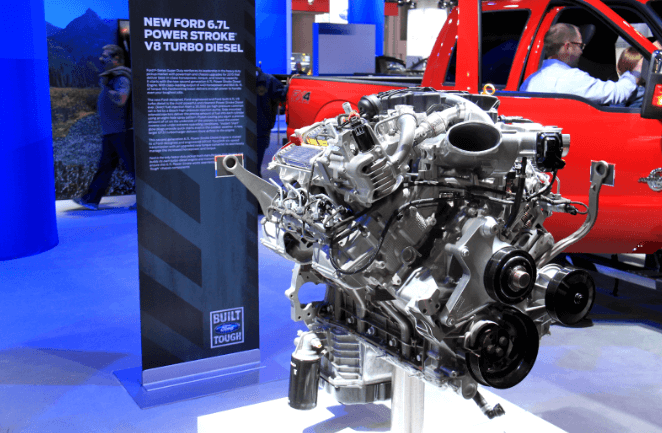
This engine combines powerful performance with excellent fuel economy, featuring a high-density cast graphite iron (CGI) cylinder block, aluminum cylinder heads, and a reverse-flow design. The turbocharger is mounted within the engine's engine valley, enhancing responsiveness. Over the years, continuous upgrades to the turbocharging system, fuel injection system, cooling system, and internal components have consistently improved the engine's performance and reliability.
Today, the 6.7-liter Powerstroke engine remains a leader in heavy-duty diesel engines, trusted for traction, commercial applications, and high-performance modifications.
Key Technical Specifications of the 6.7L Powerstroke
Take a look at Ford 6.7 Powerstroke specs (standard configuration):
| Specification | Details |
| Engine Type | 90° V8 turbo diesel with common rail direct injection |
| Displacement | 6.7L (406 cu in / 6,651 cc) |
| Bore x Stroke | 3.90 in x 4.25 in (99 mm x 108 mm) |
| Compression ratio | ~15.8:1 (most models) |
| Fuel System | High‑pressure common rail direct injection (diesel) |
| Turbocharger type | Electronically controlled variable geometry turbocharger (VGT) |
| Emission system | EGR, Diesel Particulate Filter (DPF), SCR with DEF — modern controls for emissions compliance |
| Transmission | 6R140 TorqShift 6‑speed (older models), 10R140 TorqShift 10‑speed (newer models) |
| Drive type | Rear‑wheel drive (RWD) or four‑wheel drive (4x4), depending on truck configuration |
| Cooling system | Liquid engine cooling with charge‑air cooler (standard) |
| Electrical system | 12‑volt dual battery (factory HD setup) |
| Traction & payload context | Traction varies by model/axle; payload depends on truck configuration — payload ratings are set by the chassis model, not the engine itself (Ford Super Duty payload ranges vary widely by 4x2/4x4 and trim) |
6.7 Powerstroke bolt torque specs and values vary by year and component. Always confirm head bolt torque specs and 6.7 Powerstroke exhaust manifold torque specs with factory documentation.
6.7 Powerstroke Horsepower and Torque by Year
Here's a simplified breakdown of 6.7 Powerstroke hp and torque across major updates:
- 2013 6.7 Powerstroke specs: 400 hp / 800 lb-ft
- 2014 6.7 Powerstroke specs: 400 hp / 800 lb-ft
- 2015 6.7 Powerstroke specs: 440 hp / 860 lb-ft
- 2016 6.7 Powerstroke specs: 440 hp / 860 lb-ft
- 2017 6.7 Powerstroke specs: 440 hp / 925 lb-ft
- 2018 6.7 Powerstroke specs: 450 hp / 935 lb-ft
- 2019 6.7 Powerstroke specs: 450 hp / 935 lb-ft
- 2020 6.7 Powerstroke specs: 475 hp / 1,050 lb‑ft
- 2021 6.7 Powerstroke specs: 475 hp / 1,050 lb‑ft
- 2022 6.7 Powerstroke specs: 475 hp / 1,050 lb-ft
- 2024 6.7 Powerstroke specs: 475 hp / 1,050 lb-ft
- 2025 6.7 Powerstroke specs: 475 hp / 1,050 lb-ft
- 6.7 HO Powerstroke specs (2024+): 500 hp / 1,200 lb-ft
That's not a minor increase in 6.7 Powerstroke hp. It's a steady climb that keeps the engine competitive year after year.
Key Features of the 6.7 Powerstroke Engine
Overall, the 6.7 Powerstroke delivers strong low-RPM torque, modern transmission pairing and improved drivability compared to earlier diesel generations. It balances work capability with daily comfort well.
1. First Generation (2011–2014)
Introduced the reverse-flow design and single sequential turbo. Power was solid at 400 hp and 800 lb-ft. Some early 2011–2012 trucks experienced turbo bearing concerns, but the foundation was strong.
2. Second Generation (2015–2019)
A redesigned turbo improved durability and throttle response. Higher injection pressure and stronger internals pushed output into the 900 lb-ft range. These years helped cement the engine’s reputation.
3. Third Generation (2020–Present)
The switch to the 10R140 TorqShift transmission improved drivability and acceleration. Torque crossed 1,000 lb-ft, and the 6.7 High Output Powerstroke specs now lead the heavy-duty towing segment.
6.7 Powerstroke vs Cummins vs Duramax (Performance Specs)
When buyers compare 6.7 Powerstroke, 6.7 Cummins, and 6.6 Duramax performance specs, it usually comes down to priorities.
| Engine | Horsepower | Torque | Turbo Type | Best For |
| 6.7 Powerstroke HO | ~500 hp | ~1,200 lb‑ft | VGT | Highest towing & advanced performance |
| 6.7 Cummins HO | ~420 hp | ~1,075 lb‑ft | VGT/IHI | Strong low‑end pulling and durability |
| 6.6 Duramax | ~470 hp | ~975 lb‑ft | VGT | Balanced power & smooth response |
Which Diesel Engine Is Right for You?
- Powerstroke: Overall performance and advanced transmission pairing, excellent for heavy towing and tech features.
- Cummins: Renowned for low-end torque and mechanical simplicity.
- Duramax: Quick throttle response and smooth daily drivability.
FAQs About 6.7 Powerstroke Specs
Conclusion
The 6.7L Powerstroke has come a long way. It has grown from 400 hp and 800 lb-ft to today's 500 hp and 1,200 lb-ft High Output models. The latest 6.7 Powerstroke specs show steady improvements in power, towing ability, refinement, and transmission performance.
Which diesel engine is right really depends on how you use your truck. If towing heavy loads or needing advanced tech is a priority, the Ford 6.7 Powerstroke still leads the pack.
For those wanting to get even more out of their 6.7 Powerstroke—whether it's better exhaust flow, lower backpressure, or just more performance —Vigor Diesel offers DPF delete pipes designed specifically for these trucks, making towing, hauling or performance upgrades more reliable.